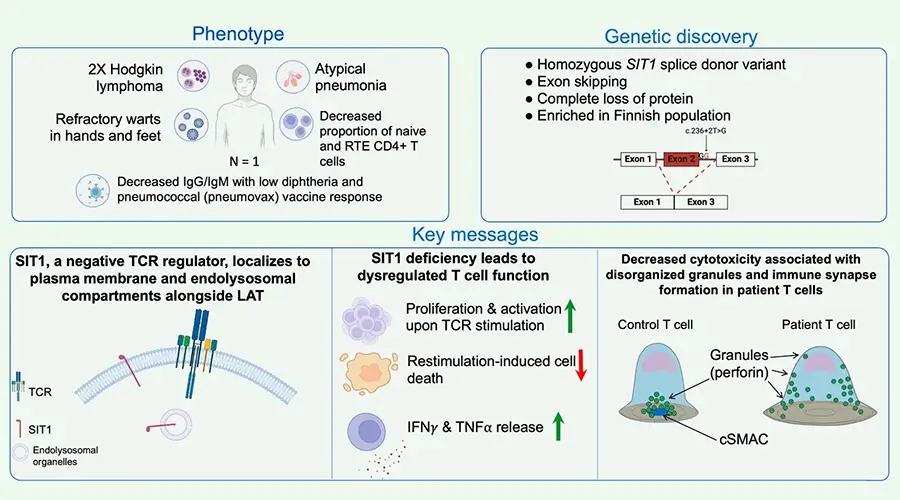
We are pleased to announce the publication of our latest paper, Homozygous loss-of-function mutation in SIT1 leads to combined immunodeficiency due to dysregulated T-cell receptor signaling, now available in the Journal of Allergy and Clinical Immunology.
Abstract
Background
The transmembrane adaptor protein SIT1 (signaling threshold–regulating transmembrane adaptor 1) is a negative regulator of T-cell receptor (TCR) signaling, but its role in human immunity remains poorly characterized.
Objective
We sought to investigate the molecular consequences of a biallelic loss-of-function SIT1 variant in a patient with combined immune deficiency and recurrent lymphoma.
Methods
Exome sequencing identified the putative disease-causing variant. Immunophenotyping and functional assays were performed on patient-derived lymphocytes and CRISPR-Cas9–mediated SIT1 knockout (KO) T cells from healthy donors. Transcriptomics, proteomics, and super-resolution imaging were used to characterize SIT1 deficiency.
Results
The c.236+2T>G variant caused exon 2 skipping and complete SIT1 loss. Patient/KO T cells revealed skewed T-cell subsets, increased activation and proliferation, and impaired CD8+ cytotoxicity. Transcriptomic analysis demonstrated that SIT1 KO upregulated cytokine signaling, metabolic reprogramming, and cell cycle hallmarks.
Proteomic analysis confirmed SIT1’s association with Src and receptor tyrosine kinases and suggested a novel role for SIT1 in intracellular vesicle trafficking. Imaging revealed SIT1 localized to plasma membrane and TCR microclusters, colocalizing with endolysosomal compartments and linker for activation of T cells.
Patient T cells exhibited impaired immune synapse maturation and vesicle accumulation on TCR stimulation. Population data link this rare SIT1 variant to lymphoid malignancy and reduced risk of autoimmunity.
Conclusions
We report the first patient with biallelic loss-of-function SIT1 variant, establishing SIT1 as a critical regulator of T-cell activation, proliferation, and synapse organization, implicating SIT1 deficiency as a novel cause of combined immunodeficiency, predisposing to lymphoid malignancy.