We’re pleased to share that our latest paper titled Protocol for Non-viral HDR-based CRISPR/Cas9 platform for small custom editing in primary T cells was accepted for publication in Frontiers in Genome Editing, and is currently available as a preprint in bioRxiv.
Abstract
CRISPR/Cas9 gene editing is a promising tool to correct pathogenic variants for autologous cell therapies, targeting monogenic diseases such as inborn errors of immunity (IEI). Furthermore, it can be used as a tool for disease modelling to study normal and pathological variations of the immune system.
Here we present a detailed protocol for an efficient and customizable T cell single nucleotide variant (SNV) correction platform based on homology-directed repair (HDR). The protocol details every step of the process, which starts with custom CRISPR/Cas9 reagent design of guide-RNAs (gRNAs) and repair templates for editing a novel target with no previously published reagents.
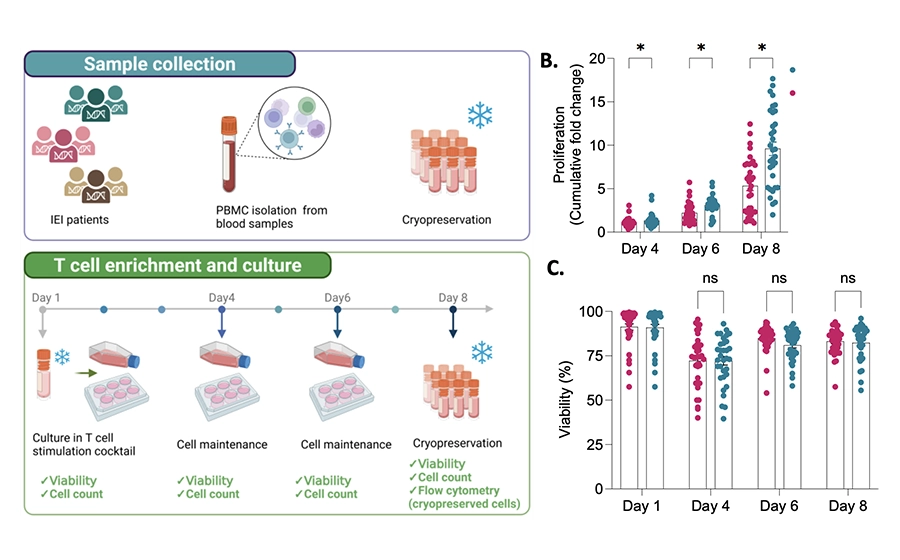
Furthermore, we describe the strategy of reagent design to assess on-target HDR editing using droplet digital PCR (ddPCR). Next, we detail the T cell platform itself, and present effective strategies to stimulate PBMCs ex vivo to promote CD4+ and CD8+ T cell activation and proliferation, which we have validated in 32 unique IEI patients.
Next, we present the workflow of gene editing T cells using nucleofection and CRISPR ribonucleoprotein (RNP) complexes for efficient editing that preserves high cell viabilities and up to 80% HDR.
Finally, we present a flow cytometry panel that assesses the immune cells present at the end of the platform, including characterization of memory and effector T cell populations and status of T cell exhaustion.